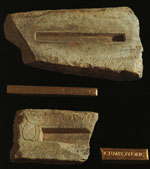
In the regions which today constitute Carinthia, western Tyrol, the southern region of the province of Salzburg, south-west Styria and part of northern Slovenia, the nucleus of a Celtic central power had developed by the early 2nd c. B.C., which by the mid-1st c. B.C. was known as regnum Noricum. Livy and other ancient authors report on the numerous attempts at immigration into upper Italy by groups belonging to the Alpine Celtic peoples after 186 B.C., which led to diplomatic contacts between Rome and these Galli transalpini, contacts which were also supported by military intimidation on the part of the Imperium Romanum. The immediate results of these first contacts were the foundation of colonia Aquileia in 181 B.C. in order to support Rome’s claims on the eastern border region of Gallia Cisalpina, and an agreement with the Alpine Celts, designated as a hospitium publicum, in 171 B.C. The resulting contract, which today would be described as a trade agreement and a pact of non-aggression, guaranteed to both sides unendangered residence and trade in the regions belonging to the treaty partners.
Due to the presence of surprisingly rich gold deposits, whether in the central Eastern Alps around the Großglockner or in the region around the upper Save Valley in the area of the tribes of the Taurisci, we learn from the historians Polybius and Strabo of intensive trading contacts and the presence of numerous Roman prospectors and merchants in the southern Eastern Alpine regions in the late 2nd c. B.C. At this period, active gold trade and an indigenous coin minting, perhaps dating back prior to the mid-2nd c. B.C., existed amongst the Noricans as well as the Taurisci.
After a long hiatus in the written sources, the regnum Noricum first reappears in the historical record with the onset of Caesar’s Gallic Wars. At that time, the Norican king Voccio must have been one of the most important suppliers of weapons to the Roman generals. He also aligned himself with Caesar during the civil war and offered him the support of a cavalry regiment.
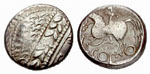
With these events, the two most important raw materials which made Noricum interesting for Rome have been mentioned: gold, and iron, similar to steel through specific processing techniques (ferrum Noricum), and the weapons and instruments made from it. Perhaps as a direct consequence of the intensified contacts between Noricum and Caesar, large settlements arose around the mid-1st c. B.C. on the border of the Cisalpine region and in the area of southern Noricum. In these settlements, procuratores of the freedman class from large trading houses from Aquileia, Patavium, Tergeste and other northern Italian cities occupied permanent outposts; furthermore, numerous freeborn merchants are also attested. While Nauportus, set up in the north east of Gallia Cisalpina in the Augustan period, was absorbed by the new colonia Iulia Emona (Ljubljana), perhaps as a result of the new organisation of upper Italy (regio X), the trading vicus of Iulium Carnicum located on the northern border between Italy and Noricum developed into a municipium at the latest during the reign of Claudius.
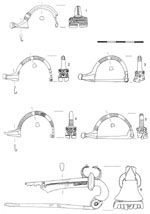
In Noricum itself, in addition to other emporia which are scarcely attested in the archaeological record, the settlement on the Magdalensberg (mid Carinthia), already providing evidence of urban structures in the Augustan period, above all deserves mention as a site not only for the exchange of wares but also for the manufacture of half-finished and finished products. When the city was abandoned after a good 100 years of settlement, it must have had close to 3000 inhabitants, of which hundreds of inscriptions attest that immigrant traders or merchants who were only there temporarily constituted significant groups. Furthermore, the following important pieces of evidence for commerce and trade can be mentioned: manufacturers’ signatures on wares, purse fastenings with the owners’ names, scraffito on walls with sums and business transactions, inscriptions on amphora, and much more.
While it was earlier assumed that the mountain peak of Magdalensberg constituted a Norican princely residence, possibly even equipped with its own mint, and in the shadow of which the Roman traders took up residence, in the meantime it is now argued that the massive stone structures on the mountain peak erected in the (early?) Augustan period might represent a sanctuary, laid out according to Mediterranean prototypes on terraces and provided with large stoa structures. Excavations carried out in 2006 have now finally confirmed the existence on the summit of a podium temple of Roman structural form.
The life-size bronze statue of a naked youth – a chance find from 1502 – now securely dated to the Augustan period but its interpretation still hotly disputed, can be discussed here. The statue, known as the ‘Youth from Helenenberg’ (as the Magdalensberg was formerly called), can be identified on the basis of a donor’s inscription on its right thigh as a dedication on the part of two procurators from trading families from Aquileia, and originates from a Mediterranean, probably Italian workshop. Along with the statue, a bronze object in the form of a shield (now unfortunately lost) was also found; this had a similar dedicatory inscription referring to three donors, amongst whom once again an Aquileian, L(ucius) Barbius L(ucii) f(ilius) Philoterus was recorded.

Finally, a foundation myth handed down in Byzantine script, its meaning however only recently recognised, may be mentioned in connection with the manner in which the inhabitants of Old-Virunum – as the settlement may be termed – saw themselves. Here, Virunum is explicitly identified as a mountain site, laid out and inhabited by Italians in Noricum. Its name may be traced back to the heroic deeds of a single individual (vir unus), who was credited with freeing the region from a gigantic wild boar. The myth is a fine example, and perhaps even the most recent, of a type of foundation myth connected with a boar hunt, and common in particular throughout Asia Minor, for example at Prusa in Bythinia, Aphrodisias in Caria, and, above all, at Ephesos. Trading contacts between the settlement on the Magdalensberg and Ephesos can be proven already in the Augustan period via imports through Aquileia. Furthermore, a strong group of inhabitants originating from the orient can be adduced on the basis of onomastic material, for example A. Poblicius D. l. Antioc(us), one of the donors of the bronze statue of the youth.
Leaving aside the explicit reference to the construction of the city by Italians, the incorrect etymological explanation for the city name in the aetiological legends also reveals typically Roman-antiquarian tendencies. The fact is that, seen from the viewpoint of religious historians and linguists, Virunum is much more likely to be connected with an ‘ancestor’, and therefore more likely with a hero of regional significance who possessed a sanctuary on the Magdalensberg.
Under his protection, in a similar fashion to the almost contemporary situation at Aphrodisias in Caria (western Turkey), a proper trading city could have developed out of the establishment of regular, and later permanent, markets. Evidence of the contemporary development of Roman settlements at late Latène-period sanctuaries after the Augustan era is also preserved at Teurnia and at the Frauenberg near Solva. In contrast, there is no evidence at any of the Roman cities of Noricum or Pannonia for large-scale settlements prior to these, as for example was the case in tres Galliae.
With the establishment of the seat of the Norican governor at Virunum, a new foundation in the Glan valley dating to the Claudian period, the development of the trading settlement on the nearby Magdalensberg came to an end. Irrespective of whether the Magdalensberg settlement already bore the name of ‘Virunum’ or not, in a certain sense it must be understood as the predecessor of the new ‘capital city’, perhaps together with other settlements in the surrounding area. Scholars are unanimous that the transferral of the city was associated with the now much more convenient communication conditions and the shortening and simplification of transportation routes.
Around the mid-1st c. B.C., roughly contemporary with the establishment of the settlement on the Magdalensberg, the regnum Noricum, encouraged by an at least benevolent neutrality on the part of Rome, must have exploited the catastrophic defeat of the Boii (with their political centre near Bratislava) against the Dacii, and the subsequent weakening of the Dacian realm; thereafter it pushed its territorial borders to the east as far as the Balaton (lacus Pelso) and to the north as far as the Danube. With this action, an extensive stretch, measuring many hundreds of kilometres, of a long-distance trading route of the utmost importance, the Amber Route, came under Norican control.
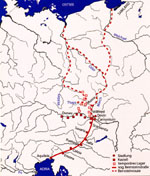
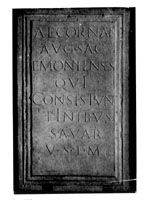
While the northern part of Illyricum (Pannonia) and also the Raetian-Vindelican area (Raetia) had to be bloodily subdued during the great Alpine campaign of 16/15 B.C., whereby the rebellion of Bato in the east in 6 A.D. led to the breaking off of further plans of conquest which would have crossed the Danube, the regnum Noricum seems to have been incorporated into the Imperium Romanum at the same time without great military resistance. As early as during the reign of Augustus or that of his adoptive son Tiberius (14-37 A.D.), according to the lexicographer Pliny a trading settlement, oppidum Iulium Scarbantia (Sopron) grew up along the Amber Route to the south of the Neusiedler See. Furthermore, the later capital city of the province of Pannonia, colonia Claudia Savaria, must already have existed in the first half of the 1st c. A.D. as a trading settlement. Here such large groups of traders settled so quickly that numerous associations were created, of which the collegium of the merchants from Emona (Ljubljana) may well be the earliest. Traders from the Rhineland and from the Euphrates region are, however, also attested. The development of the canabae legionis at Carnuntum also began around the mid-1st c. A.D. at the latest, where a legion now guarded the crossing of the Danube and with it the Roman termination of the Amber Route. At any rate, at this time the largest portion of this important trade route must have been separated from Noricum and transferred to Illyricum or to the new province of Pannonia. Only a small section in the south near Celeia remained to Noricum.
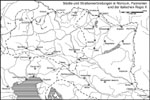 Under
Emperor Claudius, the now much smaller area of the province Noricum was restructured
and administered by an equestrian procurator Augusti. At that time, five municipalities
simultaneously were created: Aguntum (Dölsach near Lienz in eastern Tyrol),
Teurnia (St. Peter im Holz near Spittal an der Drau), Virunum (Zollfeld not
far from Klagenfurt) and Celeia (Celje, northern Slovenia) lay in the south,
all separated by one pass and a day’s journey from Italy. In the north-east,
Iuvavum (Salzburg) was added. Under Vespasian (69 -79 A.D.), a sixth city followed,
Flavia Solva (Wagna near Leibnitz in south-east Styria). All of the settlements
which were elevated to the rank of a city in the 1st c. A.D. display consistent
characteristics: they are located on large rivers or at river crossings, that
is at intersections of prehistoric transportation routes; they possess an Augustan
or slightly later settlement core; and in more or less close proximity an important
settlement, or often numerous settlements, dating to the late Latène period
and having the function of a central site (for example Celeia and Iuvavum),
or a locally important Celtic sanctuary (Magdalensberg and Frauenberg as precursors
for Virunum and Flavia Solva, Holzerberg for Teurnia) can be identified.
Under
Emperor Claudius, the now much smaller area of the province Noricum was restructured
and administered by an equestrian procurator Augusti. At that time, five municipalities
simultaneously were created: Aguntum (Dölsach near Lienz in eastern Tyrol),
Teurnia (St. Peter im Holz near Spittal an der Drau), Virunum (Zollfeld not
far from Klagenfurt) and Celeia (Celje, northern Slovenia) lay in the south,
all separated by one pass and a day’s journey from Italy. In the north-east,
Iuvavum (Salzburg) was added. Under Vespasian (69 -79 A.D.), a sixth city followed,
Flavia Solva (Wagna near Leibnitz in south-east Styria). All of the settlements
which were elevated to the rank of a city in the 1st c. A.D. display consistent
characteristics: they are located on large rivers or at river crossings, that
is at intersections of prehistoric transportation routes; they possess an Augustan
or slightly later settlement core; and in more or less close proximity an important
settlement, or often numerous settlements, dating to the late Latène period
and having the function of a central site (for example Celeia and Iuvavum),
or a locally important Celtic sanctuary (Magdalensberg and Frauenberg as precursors
for Virunum and Flavia Solva, Holzerberg for Teurnia) can be identified.
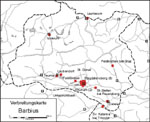 All
of the long-distance trade routes from Noricum to the south led over Emona in
the east and Iulium Carnicum in the north directly to the large port of Aquileia,
where a branch of the Amber Route leading over Dalmatia to Greece also terminated.
In fact the early Norican and western Pannonian cities were indirect foundations
of Aquileia, whose trading houses placed the major contingent of the stationary
procuratores, for example the Barbii, in the trading settlements which
were elevated to municipalities. After the yield from the Norican gold mining
industry, which demonstrably flowed into the Imperial coffers already during
the reign of Caligula, the second greatest export article of the region remained
iron extraction and processing. The mines which were leased by the state (ferrariae
Noricae) apparently remained in the hands of the leading merchants of Aquileia
until the later 2nd c. A.D. Not only the mine works in the southern
and central Alpine regions, however, but also the extraction, smelting and commerce
of iron ore from beyond the alpine area played a significant role in the foundation
of trading stations. Oppidum Iulium Scarbantia (Sopron), established
at the latest during the Tiberian period, lay in the centre of the iron industry
region of Burgenland – western Hungary. Even though archaeological evidence
has not yet come to light, the location of the vicus Lauriacum at the
mouth of the river Enns where it enters the Donau can most probably be explained
already by ca. mid-1st c. A.D. as a transportation port for iron
(ore) from the surrounding Enns-Steyr river system, still known today as ‘Eisenwurzen’.
Furthermore, the fact that the Romans took up the Hallstatt settlement again
is equally more likely to be related to the smelting of iron than to salt mining,
which at that time had been abandoned. Additionally, the so-called inner-Norican
route ran at first along the rivers Enns and Steyr, then over the Pyhrnpass
(forking off towards Iuvavum in the upper Enns valley) and over Liezen into
the Palten valley and onwards into the Mur valley, whence Flavia Solvia could
easily be reached, or even Virunum via a few small passes. Scarbantia and Lauriacum
in particular attract attention as early exceptions, not only due to their early
date but also to their location within the context of Roman settlement in the
Danube region.
All
of the long-distance trade routes from Noricum to the south led over Emona in
the east and Iulium Carnicum in the north directly to the large port of Aquileia,
where a branch of the Amber Route leading over Dalmatia to Greece also terminated.
In fact the early Norican and western Pannonian cities were indirect foundations
of Aquileia, whose trading houses placed the major contingent of the stationary
procuratores, for example the Barbii, in the trading settlements which
were elevated to municipalities. After the yield from the Norican gold mining
industry, which demonstrably flowed into the Imperial coffers already during
the reign of Caligula, the second greatest export article of the region remained
iron extraction and processing. The mines which were leased by the state (ferrariae
Noricae) apparently remained in the hands of the leading merchants of Aquileia
until the later 2nd c. A.D. Not only the mine works in the southern
and central Alpine regions, however, but also the extraction, smelting and commerce
of iron ore from beyond the alpine area played a significant role in the foundation
of trading stations. Oppidum Iulium Scarbantia (Sopron), established
at the latest during the Tiberian period, lay in the centre of the iron industry
region of Burgenland – western Hungary. Even though archaeological evidence
has not yet come to light, the location of the vicus Lauriacum at the
mouth of the river Enns where it enters the Donau can most probably be explained
already by ca. mid-1st c. A.D. as a transportation port for iron
(ore) from the surrounding Enns-Steyr river system, still known today as ‘Eisenwurzen’.
Furthermore, the fact that the Romans took up the Hallstatt settlement again
is equally more likely to be related to the smelting of iron than to salt mining,
which at that time had been abandoned. Additionally, the so-called inner-Norican
route ran at first along the rivers Enns and Steyr, then over the Pyhrnpass
(forking off towards Iuvavum in the upper Enns valley) and over Liezen into
the Palten valley and onwards into the Mur valley, whence Flavia Solvia could
easily be reached, or even Virunum via a few small passes. Scarbantia and Lauriacum
in particular attract attention as early exceptions, not only due to their early
date but also to their location within the context of Roman settlement in the
Danube region.
 In
addition to the roads, however, rivers which were capable of supporting barges
were the actual bearers of the trade. Furthermore, this fact explains the preferred
location of cities at river crossings. From Salzburg, the trade could be handled
extensively over the Salzach and Inn and finally downriver along the Danube.
Thus the presence of Italian merchants, attested via inscriptions, even at Boiodorum
(Passau) on the border of the empire is not surprising; here, a collegium
bubulariorum (association of beef merchants) and the wine importer Essimnus
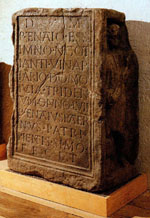
from Trient were active. At Celeia, which was connected to the Save river network
over the Savinja river, a number of important merchants were situated, one of
whom, Lucius Servilius Eutyches together with his helmsmen (gubernatores)
erected a votive altar to the local goddess Adsalluta.
In
addition to the roads, however, rivers which were capable of supporting barges
were the actual bearers of the trade. Furthermore, this fact explains the preferred
location of cities at river crossings. From Salzburg, the trade could be handled
extensively over the Salzach and Inn and finally downriver along the Danube.
Thus the presence of Italian merchants, attested via inscriptions, even at Boiodorum
(Passau) on the border of the empire is not surprising; here, a collegium
bubulariorum (association of beef merchants) and the wine importer Essimnus
from Trient were active. At Celeia, which was connected to the Save river network
over the Savinja river, a number of important merchants were situated, one of
whom, Lucius Servilius Eutyches together with his helmsmen (gubernatores)
erected a votive altar to the local goddess Adsalluta.
The administrative reforms of the province of Noricum under
Marcus Aurelius in the course of the Marcomanni wars signified at the same time
an end to old dependencies and alliances. The stationing of the reorganised
legio II Italica in Lauriacum, and the subsequent relocation of the governorship
to the Danube region, reversed the inner Norican economic cycle. While up until
that point almost the entire trade in the region had been conducted through
northern Italy, above all via Aquileia, now, with the doubling of the Norican
army and the subsequent increase in supply requirements, thousands of soldiers,
potential customers, were stationed in the barracks of the Danube region, from
the river Inn as far as the Waldviertel. Perhaps already due to the emergency
situation caused by the defensive wars against the German hordes, although probably
far more likely due to far-reaching strategic economic measures, around 170
A.D. the south Norican  iron
mining and production was placed under direct state control, Aquileia lost an
important source of income, and the Norican tradesmen were able to disentangle
themselves from their relationships to their earlier ‘regular customers’, replacing
them with trade now oriented primarily to the north. The flowering of the province
of Noricum under the Severan emperors is illustrated by an in part luxurious
rebuilding of the destroyed cities after the devastation carried out by the
Marcomanni. The financial background for this heyday was based on the liberation
from dependency on Aquileia and other northern Italian cities, and resulted
in a new sense of self-confidence on the part of the leading civic classes,
who in these decades increasingly developed their own, typically provincial
Roman identity. Their conspicuous characteristic is the nostalgic recourse to
Celtic-Norican traditionalism.
iron
mining and production was placed under direct state control, Aquileia lost an
important source of income, and the Norican tradesmen were able to disentangle
themselves from their relationships to their earlier ‘regular customers’, replacing
them with trade now oriented primarily to the north. The flowering of the province
of Noricum under the Severan emperors is illustrated by an in part luxurious
rebuilding of the destroyed cities after the devastation carried out by the
Marcomanni. The financial background for this heyday was based on the liberation
from dependency on Aquileia and other northern Italian cities, and resulted
in a new sense of self-confidence on the part of the leading civic classes,
who in these decades increasingly developed their own, typically provincial
Roman identity. Their conspicuous characteristic is the nostalgic recourse to
Celtic-Norican traditionalism.
In contrast to the traditional view in the scholarship, which held that in the early municipalities it was above all the indigenous, originally Celtic nobility, invested with the civitas Romana bestowed ad personam, who had established themselves as the leading classes, and the plebs oppidana only had at their disposal the lower-status ius Latii, nowadays a completely different picture is emerging. An analysis of the names of civic public officials and council members (duumviri iure dicundo, aediles, quaestores, decuriones) reveals that for at least 70 % of these honestiores (families with a seat in the city council), a relationship to immigrants from the Mediterranean regions can be established; this is particularly true for families originating in Aquileia, Iulium Carnicum or Tergeste. Moreover, in these classes, gentile names based on Celtic names, or citizens with imperial naming formulas (Iulii, Claudii, Flavii) are relatively rare. It is first in the Hadrianic cities of Ovilavis and Cetium in the region beyond the border that new citizens with imperial gentile names such as ‘Ulpii’ and ‘Aelii’, as well as aristocratic landholders of Celtic descent, become prominent. Along the Amber Route the picture is very similar, although here naturally a greater portion of legionary veterans can also be identified in the cities, and in particular in the coloniae. Here residents of native origin are almost completely absent.
G. Alföldy, Noricum (London 1974).
G. Dobesch, Die Kelten in Österreich nach den ältesten Berichten der Antike. Das norische Königreich und seine Beziehungen zu Rom im 2. Jahrhundert v. Chr. (Wien – Köln – Graz 1980, 2. Aufl. 1993)
H. Friesinger — K. Pieta — J. Rajtár (Hrsg.), Metallgewinnung und -verarbeitung in der Antike (Schwerpunkt Eisen). Materialien des VIII. Internationalen Symposiums "Grundprobleme der frühgeschichtlichen Entwicklung im nördlichen Mitteldonaugebiet" Zwettl, 4.–7. Dezember 1995 (Communicationes Instituti Archaeologici Nitriensis Academiae Scientiarum Slovacae 3, Nitra 2000)
V. Gassner — S. Jilek — S. Ladstätter, Am Rande des Reiches. Die Römer in Österreich, Österreichische Geschichte 15 v. Chr. – 378 n. Chr. (Wien 2002).
M. Harding — G. Jacobsen, Die Bedeutung der zivilen Zuwanderung aus Norditalien für die Entwicklung der Städte in Noricum und Pannonia, Classica et Mediaevalia 39, 1988, 117–206.
J. Horvat, Nauportus (Vrhnika) (SAZU op. 33, Ljubljana 1990).
P. Kos — A. Šemrov, Skupna najdba keltskih in rimskih novcev v reki Ljubljanici. Doprinos h kronologiji novcev plemena Tavriskov (A hoard of Celtic and Roman coins from the Ljubljanica River. A contribution to the chronology of the coinage of the Taurisci), Arheoloski Vestnik 54, 2003, 381–395.
G. Piccottini, Norisches Gold für Rom, Rudolfinum 1999, 68–75.
M. Šašel Kos, The End of the Norican Kingdom and the Formation of the Provinces of Noricum and Pannonia, in: B. Djuri — I. Lazar (Hrsg.), Akten des IV. Internationalen Kolloquiums über Probleme des provinzialrömischen Kunstschaffens. Akti IV mednarodnega kolokvija o problemih rimske provincialne umetnosti, Celje 1995 (Situla 36, 1997) 21–42.
M. Šašel Kos, The Tauriskan Gold Mine. Remarks Concerning the Settlement of the Tauriski, Tyche 13, 1998, 207–219.
M. Šašel Kos — P. Scherrer (Hrsg.), The Autonomous Towns in Noricum and Pannonia – Die autonomen Städte in Noricum und Pannonien (Situla 40–42, 2002–2004).
P. Scherrer, Die Ausprägung lokaler Identität in den Städten in Noricum und Pannonien. Eine Fallstudie anhand der Civitas-Kulte, in: A. Schmidt-Colinet (Hrsg.), Lokale Identitäten in Randgebieten des römischen Reiches. Akten des Internationalen Symposiums in Wiener Neustadt 2003, Wiener Forschungen zur Archäologie 7 (2004) 175–187.
H. Straube, Ferrum Noricum und die Stadt auf dem Magdalensberg (mit Beiträgen von Heimo Dolenz und Gernot Piccottini) (Wien & New York 1996).