Costume
Introduction
The idea of a ‘national’ costume was well established in the Roman world.
The toga was a symbol of Roman citizenship, and the wearing of Greek costume
by those who were not native Greek had implications beyond mere fashion. Artwork
depicting Roman conquests and victories show the ‘barbarians’ in their own
costume as a way to identify them. Even after conquest there were some people
who saw themselves as Roman in that they used Roman-style names, recorded their
life details in Latin and were commemorated with Roman-style tombstones, but
still wore native costume rather than the mainstream Roman costume of the Mediterranean
region.
The sources of evidence
Pre-Roman
There are no surviving clothes from this period in Britain, so an idea
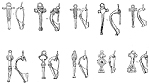
of the type of costume worn has to come from a study of the brooches and pins
that were used to fasten the clothes. How these brooches may have been used
can be deduced by looking at parallels from elsewhere in the ancient world.
Roman
Surviving fragments of Roman cloth found in the archaeological record
are re-used scraps that provide evidence of the type of cloth used, but very
little on the form of the complete clothing (Wild 2002). As in the pre-Roman
period, a study of the brooches is of great importance in the study of costume,
but as the most popular burial rite was cremation rather than fully clothed
inhumation there is no grave evidence to show how the brooches were used, and
again parallels must be looked for elsewhere.
The other key source of evidence is gravestones which have relief images
of the deceased. In Britain there are very few tombstones with images of civilians
that can be dated to the first or early second century, and those that do are
not very informative. There are more examples from the late second century
onwards, although it is often difficult to date them closely and many could
equally well be third century in date.
The evidence of brooches as part of the costume of corpses in graves and
detailed tombstone images from elsewhere in the ancient world reveal that in
many provinces men appear use a single brooch to fasten a cloak while women
could wear two brooches to fasten an over-tunic and more brooches to fasten
an under-tunic and sometimes also another to fasten a cloak. This is in contrast
with the mainstream Roman fashions, where men sometimes used a single brooch
to fasten a cloak, and women did not use brooches at all.
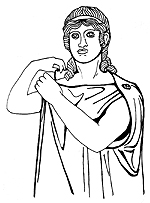 The provincial woman’s over-tunic is a so-called ‘tube-dress’, which is
an open-ended tube of cloth fastened by a brooch on either shoulder. This
is an extremely wide-spread fashion in the ancient world that is not restricted
to any one culture, with attendant variations in the way it was worn and in
particular in the design of the brooches (Croom 2000, pl. 25). Only women are
known to have worn a tunic fastened in this way, and there is no evidence that
men ever used pairs of brooches for fastening their clothes (such as cloaks).
The tube-dress typically requires two brooches to fasten it, although some
versions have it fastened on one shoulder only, but extra brooches were often
used to fasten under-tunic, cloak, or simply used as decoration, as on the
tombstone of Menimane from Mainz-Weisenau who is shown using three brooches,
and a woman from Mainz who uses six brooches (Wild 1985, pls II and XI, no.
36). The introduction of similar styles of dress could have lead to an instant
increase in demand for brooches, and would be reflected by increased numbers
of them found on archaeological sites.
Pre-Roman costume
Southern England
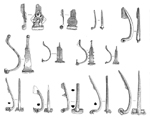 Brooches are found through-out the southern half of England. From c.15-10
BC, the number and range of brooches found increases massively, apparently
due to the importation and then copying of brooches from the Continent and
in particular Northern Gaul ((Haselgrove 1997, 51-3; Jundi and Hill 1988, 126).
In this period before the arrival of the Romans, southern Britain was already
open to cultural influences from across the Channel due to alliances and kinship
networks as well as trading links, an influence that can be clearly seen in
the importation of pottery and wine (Haselgrove 1997, 58).
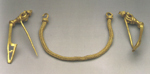
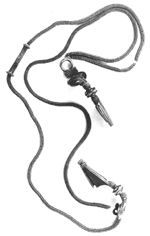
 On the whole it is impossible to distinguish between possible male cloak
brooches and female tunic brooches. However, a number of brooches have been
found in pairs connected by a chain implying that they were being worn at the
same time, which would suggest they
were worn by women as the only known use of a pair of brooches in the ancient
world is to fasten a woman’s dress. An example of these paired brooches comes
from the Winchester Hoard dated to 75 – 25 BC. which consisted of two pairs
of brooches, one chain, two torcs and two bracelets (Hobbs 2003, 60; fig. 31).
As the brooches and chain were made from gold, it
suggests that at least the richer members of society were wearing the tube-dress
in southern Britain.
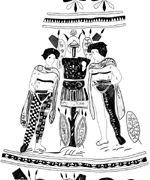
 The evidence for male costume is less clear-cut. A fragment of a decorated
toga or cloak from a statue found in North Africa and dated to the early third
century has an image of two prisoners flanking a trophy and it has been argued
that the figure on the left is a British prisoner (Piggott 1968, 130). If the
native style of dress had not changed much, and if the artist’s idea of what
a Briton looked like is correct and this is not just a pattern-book ‘barbarian’,
it might give an idea of the costume of a British man. He is shown wearing
tight-fitting trousers with a different check pattern on either leg, no tunic,
and a short cloak fastened on the right shoulder. Roman
artists like to emphasize the importance of trousers and play down the importance
of the tunic in barbarian fashions, as this made a very distinctive and visible
contrast to Italian clothing styles where the tunic was all-important, but
British men presumably also wore a tunic, at least in winter.
Northern Britain
Brooches are rarely found in the north. There are two alternative suggestions
for the costume in this area:
1) They wore similar clothes to the tribes in the south of the country,
but did not use metal fasteners. Women might have worn a tube–dress that was
sewn at the shoulder rather than fastened by brooches and men wore a cloak
fastened by a wooden pin (similar to the wooden ‘thorn’ Tacitus says some Germans
used on their cloaks; Germania, 17).
2) They wore different styles of clothes that did not need to be fastened.
Women might have worn a T-shaped sewn tunic, and men capes rather than cloaks.
There were other cultural differences between the tribes of the two areas:
in the south there was contact with the Continent, there was extensive use
of pottery, and an interest in make-up by at least some members of society
is shown by the manufacture of ‘cosmetic sets’ that are not found in the north.
It therefore seems likely that there was also a difference in the costumes
worn in the two areas.
Early Roman (first to mid second centuries)
Southern England
 After the Roman invasion, the same type of Continental brooches continued
to be used, suggesting there was no immediate change in costume. There are
some styles of brooch that appear to arrive with the army itself, and may well
be the cloak brooches of the soldiers (such as the so-called ‘Aucissa’ type).
Soon afterwards, purely British designs of brooches start to appear that are
not found on the Continent. Amongst these are a group of designs which have
a loop (often called a ‘head-loop’) incorporated into them.
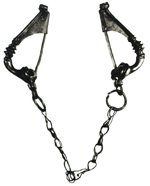
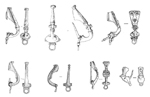 One such design is the ‘trumpet’ brooch. This first appears c.AD75
in the south (and probably not much later in the north) and continues up until
at least the middle of the second century (Bayley and Butcher 2004, 160-4).
A number of examples have been found where two brooches are linked by a chain,
such as the examples from Chorley and Stanwix and further examples have been
found with a broken chain still attached to a single brooch. This suggests
that while the design of brooch has changed, the tube-dress is still being
worn by women up until at least the mid-second century. If women
are wearing the same costume, then maybe the men were also.
Northern Britain
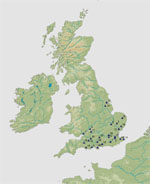
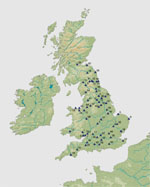 The map does not record every single site where a trumpet brooch has been
found, but does show that by the late second century trumpet brooches were
found on Roman sites through-out the country. This means that the fashion
for wearing the tube-dress spread with the arrival of the Romans up into the
north. The range of brooches with head-loops found
at Arbeia Roman Fort is very similar to those from Richborough. The women
in towns, forts and vici adopt a new fashion, not from the Mediterranean, but from southern Britain,
where they continue to wear their pre-Roman fashions with new brooch designs.
There are few brooches found on native sites in the north, although Roman pottery
on the sites show they had contact, perhaps indicating that in rural areas
people continued to wear their own pre-Roman costume. However, finds of any
kind are often very few on native sites.
There are very few tombstones that can be dated to the first century or
early second century, and fewer still with images of civilians. There is one
from Ilkley in Yorkshire dated to either the late first or early second century
that shows a woman sitting in a chair, but the details of her tunic are hidden
under a large mantle (CSIR I.3.98).
Mid Roman (mid second to early third centuries)
From the mid second century the number of brooches found on sites in Britain
declines, and the types with head-loops go out of production altogether, with
the implication that tube-dresses fastened by brooches were no longer worn.
At the same time, tombstones with images become more popular, and some of these
show people wearing a new style of costume.
Northern England
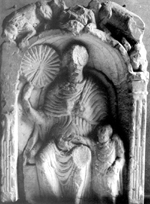
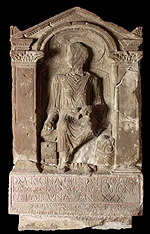 The tombstone of Regina from Arbeia Roman Fort, which is dated to the
second half of the second century, shows this new fashion. She is wearing
an unbelted tunic with elbow-length sleeves over a longer under-tunic. It is
a T-shaped tunic with relatively wide sleeves, and does not require the
use of any brooches. This unbelted tunic has been called the ‘Gallic coat’
(Wild 1968, 168; the word ‘coat’ is used in its old-fashioned sense and not
in its modern sense of an out-door protective garment). A version of this tunic,
short for men and long for women, was worn in Gallia and Germania from at least
the early second century until the late third or early fourth century. Women
wore a mantle draped round them as outer wear, which was not fastened by a
brooch. The tombstone of the mother and son from Carlisle shows a short version
wrapped round her shoulders.
 The
short version of this tunic, often worn over an under-tunic and with a scarf
round the neck, was worn by men in Gaul and Germania (Wild 1985, figs
1, 16, pl. III; Croom 2000, fig. 69), and was probably also worn by men in
Britannia, but on most of the tombstone reliefs the details of sleeves and
the presence or absence of a belt that distinguish the coat from a tunic are
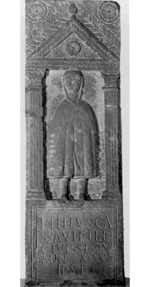
hidden under a long hooded cape, as on the son on the Carlisle tombstone, or
on the tombstone of Philus from Cirencester from southern Britain. Men
wearing the Gallic coat are never shown wearing a cloak, but instead use a hooded
cape as outer wear. As the cape is sewn completely or partially down
the front, a brooch is not required for the man’s costume either. Although
some civilian men continue to use a cloak, from the late second century onwards
cloaks are mainly worn by soldiers.
The Gallic coat is very different from the earlier tube-dress for women
and trousers for men, moving from a minimum need of a single brooch for a man
and anywhere from one to six brooches for a woman, to a costume that required
none at all. It was also very different from the accepted costume of the Mediterranean
region, as at this period generally only the poor would appear outside their
house without a belt. As the Gallic coat was worn in the other north-west provinces
from the early second century, this is another fashion introduced to Britain
from the Continent rather than from the Mediterranean region.
Southern England
It is assumed, from the lack of brooches, that the ‘Gallic coat’ was also
worn in southern England, but there is a total lack of tombstones with full-length
images of civilians in the region to confirm this. It is impossible to tell
whether this new fashion spread from the south up to the north, as with the
earlier fashion, or came first to the military in the north and spread south.
Footwear
There was perhaps a greater change in footwear fashions than in clothing
during the first century before and after the arrival of the Romans, possibly
because there was a greater difference between British and Roman leather-working
skills than there was between their cloth-making skills. The British preserved
leather using oil, fat or smoking, while the Romans introduced the use of vegetable-tanned
leather with its superior water-proofing qualities (van Driel-Murray 2001,
185), and brought in the use of hob-nails to extend the life of shoe soles.
It seems apparent that even while pre-Roman styles of clothing continued to
be worn, Roman styles of footwear were adopted with enthusiasm, particularly
by women. The newly introduced sandal, for example, was worn by women and children
before it became popular with men (ibid.,192). The fashions for shoes and boots changed rapidly over time with some styles
lasting only 30 or 40 years, but the same types are found through-out the north-west
provinces and there does not appear to be any specific British types.
TWM
Bibliography
Bayley, J. and Butcher, S. (2004) Roman
brooches in Britain: a Technological and Typological Study based on the Richborough
Collection, London.
Croom, A. (2000) Roman Clothing and Fashion, Stroud.
CSIR = Tufi, S. G. (1983) Corpus Signorum Imperii Romani: Volume
I, Fascicule 3, Great Britain, Yorkshire, Oxford.
Driel-Murray, C. (2001) ‘Vindolanda and the dating of Roman footwear’, Britannia, 32,
185-97.
HaselgroveC. (1997) Iron Age brooch deposition and chronology, in (ed.)
Gwilt, A. and Haselgrove, C., Reconstructing Iron Age Societies: New Approaches to the British Iron Age, Oxbow Mon. 71, 51-72.
Hobbs, R. (2003) Treasure. Finding our Past, London.
Piggott, S (1968) ‘An ancient Briton in North Africa’, Antiquity 42,
128-30.
Wild, J. P. (1968) ‘Clothing in the north-west provinces of the Roman
Empire’, Bonner Jahrbucher, 168, 166-240.
Wild, J. P. (1985) ‘The clothing of Britannia, Gallia Belgica and Germania
Inferior’, in (ed.) Temporini, H., and Haase, W., Aufstieg und Niedergang der römischen Welt, 12.3, 362-421.
Wild, J. P. (2002) ‘The textile industries of Roman Britain’, Britannia 33,
1-42.